Gebäude F9 der HSWT.
© Monika Müller
  • Study programme for forest engineers

Forestry department

Forests and trees are our mission. We offer excellent teaching and exciting research on the green lungs of our planet and communicate to society how important the forest is for us all.

Studying at the Forestry department

The Department of Forestry at Weihenstephan-Triesdorf University of Applied Sciences stands for scientifically sound, applied teaching. We offer a wide range of programmes for acquiring skills for the broad spectrum of professions related to trees, forests and Forestry. Students acquire practical, ecologically, economically and socially sound knowledge that enables them to make optimal long-term decisions. Our professionally qualifying Bachelor's and Master's degree programmes are characterised by direct practical relevance and in-depth knowledge. A total of around 800 students study at our department.

Events

previous
next

Forestry department - a role model for sustainability

More information

Pure practical experience in forest & forestry

All Bachelor's degree programmes include an internship semester, which can be completed at a variety of companies in Germany and abroad. The same applies to our final theses. The range of careers is just as diverse as our training and has ensured excellent career opportunities for our graduates for many years, with above-average job satisfaction, as proven by retention analyses.

The history of the Forestry department

Weihenstephan is a traditional location for academic forestry training with over 200 years of tradition:

2007/08

Conversion to Bachelor's degree programme „Engineering in Forestry“ and introduction of Master's degree programmes.

2002

Completion of the new building under Science Minister Zehetmair. There are 500-600 applicants for 120 places in the Forestry degree programme.

End of the 1990s

Demolition of the old forestry building, which will be replaced by a future-orientated timber building.

80s

Boom of the degree programme during the forest death debate in the 1980s; high demand with NC in the range of grade 1.5.

1972/73

First year in the winter semester with almost exclusively male students and two professors.

1972

Founding of the forestry faculty at the then „Weihenstephan University of Applied Sciences“; forest ranger training transferred from Lohr Forestry School to the University of Applied Sciences.

1803

Bavarian Forestry School in Weihenstephan.

Co-operations & interdisciplinary topics

The department is a partner in the Center of Forestry Weihenstephan (a unique association of all forestry institutions: TUM, LWF and HSWT) at the Weihenstephan site. We are also constantly working on new, exciting topics.

A few examples:

  • The balance of ecology - economy and social issues
  • Increased dialogue with society (forest education, forest and health)
  • New professorship: Management of urban forests
  • Digitalisation as a cross-sectional task

Working in interdisciplinary teams (national and international cooperation with other universities of applied sciences and subject areas)

Research projects

Publications

  • Thomas Kudernatsch, Markus Blaschke, Jörg Ewald

    Denser and more diverse: Vegetation change in unmanaged mountain forests of the Calcareous Alps since the mid-1980s (2026) Research Symposium “Alpine plants: evolution and challenges of life at high altitudes” 125th anniversary of the Schachen Alpine Garden, Proceedings , S. 24.

    Unmanaged natural forest reserves are important reference ecosystems fordetecting environmental change. We resurveyed permanent vegetation plotsin the strict forest reserves Schrofen and Wettersteinwald (Bavarian Alps) todetect changes in the vegetation structure and composition of thesemountain forests since the mid-1980s.The gradient covered by the investigations ranges from mixed mountainforests of the montane zone to natural spruce forests of the lowersubalpine zone and larch-pine forests of the upper subalpine zone.Particularly noticeable changes were an increase in the canopy closure ofthe stands and the establishment of a shrub layer. In addition, an increase infrequency was observed for many species of the herb layer (includingwoody regeneration), resulting in an increase in alpha diversity. The specieswith a positive reaction in the study period (“winners”) were predominantlycompetitive and vigorous forest species with comparatively higher nutrientand lower light requirements. In many cases, the increase in the frequencyof species was accompanied by an expansion of their altitudinal ranges. Asa result, the relevés of the subalpine coniferous forests and the mixedmountain forests today show an overall higher floristic similarity than in the1980s, which can be interpreted as a homogenization of the speciescomposition of the understorey vegetation.In a Central European context, the combination of canopy closure andincreased understory diversity is unusual. In our opinion, the main drivingforces behind these changes are increasing temperatures due to climatechange and changes in land use practices (cessation of timber harvesting,reduced browsing by grazing livestock and wild ungulates) and continuedhigh atmospheric nitrogen inputs.
  • Carolin Scheiter, Jörg Ewald, Martina Hofmann, Sebastian Seibold, Sebastian König, Bernd Panassiti, Christina Hartung

    Nachhaltige Almwirtschaft im Klimawandel (2026) Vertikale Wildnis (47), S. 20-21.

Contact persons

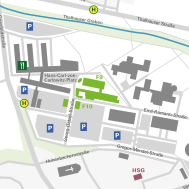
Lageplan der Gebäude F am Campus Weihenstephan.

Contact us

University of applied sciences Weihenstephan-Triesdorf
Department of Forestry
Building F9
Hans-Carl-von-Carlowitz-Platz 3
85354 Freising