Studierende entnehmen eine Wasserprobe aus einem Teich.
© Ivory Productions
  • Study programmes for prospective environmental engineers

Department of Environmental Engineering

We combine energy, water and the environment to create holistic solutions for climate, biodiversity and resource protection - practical, scientifically sound, with a circular approach and social responsibility.

Studying at the Environmental Engineering department

Our practice-oriented degree programmes are characterised in many aspects by the cooperative exchange with our partners, for example from industry, trade, administration or engineering offices. This exchange takes place in the practical semester, in many project ideas, in seminars and final theses, so that knowledge is transferred between students, partners and the department on an equal footing.

Some of our degree programmes have been established on the market for decades. However, they are also constantly adapted to innovative, didactic and socio-political trends. We offer all of our degree programmes as dual courses with intensive practical work, so that our students can gain their first professional experience during their studies. This developmental advantage can be generated in German-speaking countries through further project tasks or worldwide in semesters abroad.

With our sustainable focus on the environment, energy and water, which we offer in the Bachelor's degree programmes Energy & Water Management and Environmental Protection, students can also choose from the Master's degree programmes International Environmental Engineering, Environmental Engineering and the cooperative Master's degree programme Energy Management and Technology for further academic qualification. Our graduates are valued as managers in all areas of industry, by associations and specialised authorities and are very quickly entrusted with more advanced tasks.

News

Events

previous
next

Research projects

Publications

  • Sara Diana Leonhardt, Peer Urbatzka, Michael Rudner, Larsia Irlbeck, Sabine Brachmann, Paula Lauterwasser, Carmen Nebauer, Sandra Riesch

    • Permissions:  Peer Reviewed

    Einfluss der Bewirtschaftung auf das Blütenangebot im Jahresverlauf – Ergebnisse des Projekts APART (2026) Vortrag und Artikel im Tagungsband der 18. Wissenschaftstagung Ökologischer Landbau - WiTa 26 , S. 216: 1-4.

    Land use determines the temporal and spatial patterns of flower resources in agricultural landscapes and has a considerable impact on insect populations. We studied the availability of floral resources throughout the year 2024 in two 1 km² study areas, that are organically farmed. The average flower density of selected plant species was quantified within a hexagonal raster (mesh size 100 m) over 14 time steps, based on flower counts. Grassland management is the most important factor for the availability of floral resources whereas arable land contributes very little. Linear structures such as strips along fields or paths are not important in terms of the number of flowers they provide, but they play an essential role in connecting patches with floral resources. Clover-herb mixtures can provide the same proportion of floral resources as grassland, especially in late summer.
  • Sandra Riesch, Sabine Brachmann, Larsia Irlbeck, Carmen Nebauer, Paula Lauterwasser, Juliane Tanz, Michael Rudner, Sara Diana Leonhardt, Peer Urbatzka

    • Permissions:  Peer Reviewed

    Monitoring von Bestäubern durch automatisierte Kameras in landwirtschaftlichen geprägten Landschaften (2026) Posterpräsentation und Artikel im Tagungsband der 18. Wissenschaftstagung Ökologischer Landbau - WiTa26 , S. 227: 1-4.

    Pollinators play an important role in agricultural systems. They enhance crop productivity and help maintain biodiversity. Understanding their abundance and diversity is essential for sustainable farming practices. We used an innovative approach to studying pollinators in agricultural landscapes using automated camera traps and artificial intelligence. Our study conducts a continuous assessment of different habitat structures to evaluate their impact on the abundance and taxonomic richness of key pollinator groups. The goal is to evaluate how changes throughout the year influence the abundance and diversity of pollinator groups in different habitats. The results emphasize the importance of diverse habitats, especially field margins, for maintaining pollinator diversity and activity during the vegetation period. AI correctly assigned over 90% of hoverflies, wasps, and honeybees to the correct taxa, while wild bees, butterflies, and bumblebees were identified less accurately. The camera-trap system shows potential for standardized pollinator monitoring in agricultural environments.

Contact persons

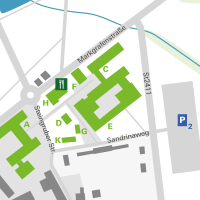
HSWT Lageplan in Triesdorf

Address

University of applied sciences Weihenstephan-Triesdorf
Department of Environmental Engineering
Building E
Markgrafenstraße 16
91746 Weidenbach