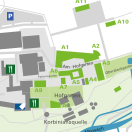
Hinter der gläsernen Fassade ist die Fakultät für Bioingenieurwissenschaften in Weihenstephan untergebracht.
  • Study programmes for prospective engineers

Bioengineering (Sciences) department

Science and practice. BioTech, Brau & Informatik - Your department for Bioengineering (Sciences).

Studying at the Bioengineering (Sciences) department

Student arbeitet im Labor mit einer Pipette.
© Ivory Productions

The Bioengineering (Sciences) department at Weihenstephan-Triesdorf University of Applied Sciences stands for scientifically sound, applied teaching - with a view to the professional profile of an engineer. This teaching is based on an understanding of biological principles in order to utilise them in a targeted and sustainable manner. Our professionally qualifying Bachelor's and Master's degree programmes are characterised by direct practical relevance and sound knowledge. A total of around 700 students study at our department.

At the Faculty of Bioengineering (Sciences), you can study for a Bachelor's degree in Biotechnology, Brewing and Beverage Technology or Applied Computer Science or opt for the Biotechnology Master's programme.

All Bachelor's degree programmes include an internship semester, which, like our final theses, is usually completed in industry or research institutions. Around 100 students go abroad every year. The demands of our degree programmes are high, but the career prospects in the relevant sectors are excellent.

Study programmes offered by the department

News

Events

previous
next

The history of the Bioengineering (Sciences) department

2012

This was followed by a Master's programme in cooperation with the University of Applied Sciences in Munich.

2011

Brewing and Beverage Technology was added to the department.

2000

Bioinformatics was added.

1990

The department was founded with Biotechnology. Since then, we have continuously expanded our expertise.

Bioengineering (Sciences) department: our network

We continuously maintain and expand our network of companies and institutions in which our alumni work successfully. They are located both in the Weihenstephan region and far beyond.

These industries and institutions are part of our network:

Companies

  • Biopharmaceutical industry & process technology
  • breweries
  • start-ups

institutions

  • Helmholtz Centre Munich
  • Fraunhofer Institutes
  • Max Planck Institutes

Research projects

Publications

  • Jörg Schäffer, Vinzenz Ackermann, Sabine Grüner

    • Permissions:  Peer Reviewed

    Water Vapour Sorption on Used Foundry Sand with Regard to its Reusability (2026)

    Sand is a widely used molding material in the foundry industry. With its availability becoming increasingly limited and transportation being cost-intensive, sustainable and environmentally friendly regeneration processes are attracting growing attention. The primary challenge in this context is the removal of binder residues remaining on the sand grains. Alkali silicates, considered as binder systems, place high demands on the specificity and sensitivity of analytical methods, since trace amounts of analyte (silicic acid) must be determined as quantitatively as possible on a chemically almost identical matrix. The present work discusses the use of water vapor sorption for the semi-quantitative determination of residual silicic acid in the presence of crystalline silicon dioxide. A particular focus is placed on modeling the sorption isotherms using the GAB and BET models. The specific surface areas determined for sands with varying degrees of binder loading are compared with the strength values of test specimens produced from these sands. A direct correlation between the achievable strength and the specific surface area is observed.Sand ist weitverbreiteter Formstoff in der Gussindustrie. Mit seiner immer knapper werdenden Verfügbarkeit und dem kostenintensiven Transport rücken nachhaltige und umweltschonende Regenerierungsverfahren zunehmend in den Fokus. Hauptaufgabe hierbei ist die Entfernung des auf dem Sandkorn zurückgebliebenen Bindemittels. Die als Binder in Betracht genommenen Alkalisilicate stellen hohe Anforderungen an die Spezifität und Sensitivität der Analytik, da Spuren von Analyt (Kieselsäure) auf einer chemisch nahezu identischen Matrix möglichst quantitativ bestimmt werden sollen. In der vorliegenden Arbeit wird der Einsatz der Wasserdampfsorption zur halbquantitativen Erfassung von Kieselsäureresten in Gegenwart kristallinen Siliciumdioxids diskutiert. Einen Schwerpunkt bildet die Modellierung der Sorptionsisothermen mit GAB- und BET-Modellen. Die ermittelten spezifischen Oberflächen verschieden stark bindemittelbelasteter Sande werden mit den Festigkeitswerten daraus hergestellter Prüfkörper verglichen. Dabei zeigt sich eine direkte Korrelation zwischen erreichter Festigkeit und spezifischer Oberfläche.
  • Mirjam Haensel, Armin Rudloff, Anton Lipetskyi, Johannes Tippmann

    Untersuchung verschiedener Einflussfaktoren auf die Alterung gängiger Getränkeschlauchmaterialen (2026) Vortrag auf dem 37. Expertentreffen Getränkeschankanlagen 2026, Weihenstephan .

  • Marius Sippel, Johannes Tippmann, Mirjam Haensel

    Untersuchung der Sauerstoffpermeation durch Getränkeleitungen aus verschiedenen Kunststoffmaterialien (2026) Vortrag auf dem 37. Expertentreffen Getränkeschankanlagen 2026, Weihenstephan .

Contact persons

Contact us

University of applied sciences Weihenstephan-Triesdorf
Bioengineering (Sciences) department
Building A3
Am Hofgarten 10
85354 Freising